
How We Built a Multi-Agent Claude System for Commercial Credit Assessment
by Sandlabs Team, Founder, Sandlabs
When a commercial lender processes a credit submission, they're juggling financial statements, borrower profiles, property valuations, compliance checklists, and dozens of supporting documents. It's a process that traditionally takes hours of manual work per submission.
We were asked to build something better. Not just faster — smarter.
The result is an AI-native credit submission platform where every step of the workflow is augmented by AI. But the most interesting piece isn't any single AI feature — it's the architecture that ties them all together.
Claude powers that stack end-to-end. Every AI decision in the platform — from query triage to financial extraction to compliance review to multi-step submission workflows — runs on Claude, chosen for its long-context reasoning, structured-output reliability, and agentic tool use.
The Problem with "Just Add a Chatbot"
The first instinct when adding AI to an enterprise app is to bolt on a generic chatbot. Ask it anything, get a response. Simple.
But in commercial lending, that falls apart fast. A question about EBITDA trends requires different data access, different formatting, and different expertise than a question about which documents are missing from the compliance checklist. A single, monolithic prompt can't handle that well.
We needed something more structured.
The Multi-Agent Triage Architecture
Instead of one AI that tries to do everything, we built seven specialized agents coordinated by an intelligent router.
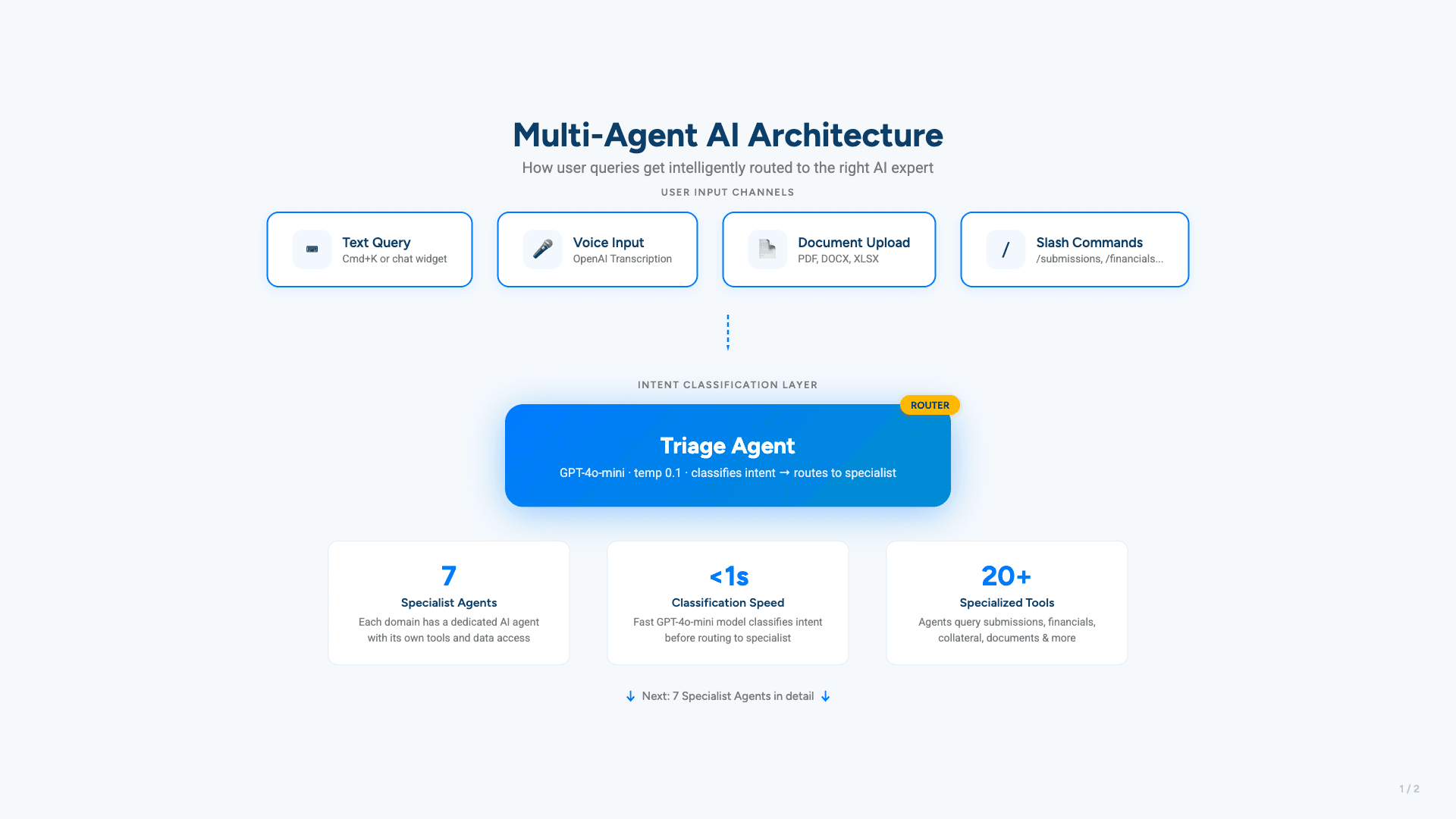
Here's how it works:
1. Input Channels
Users interact with the AI through multiple channels:
- Text queries via a floating chat widget (Cmd+K)
- Voice input with real-time OpenAI transcription
- Document uploads (PDF, DOCX, XLSX) for financial extraction
- Slash commands for direct agent access (/submissions, /financials, /collateral)
2. The Triage Layer
Every query first hits a Triage Agent — a lightweight classifier running on Claude Haiku with a temperature of 0.1. Its only job is to understand the user's intent and route to the right specialist. No tool access, no data fetching — just fast, accurate classification in under a second.
This is a deliberate design choice. By using Haiku for classification, we keep the routing instant while reserving the heavier Claude Sonnet model for the actual work.
3. Seven Specialist Agents
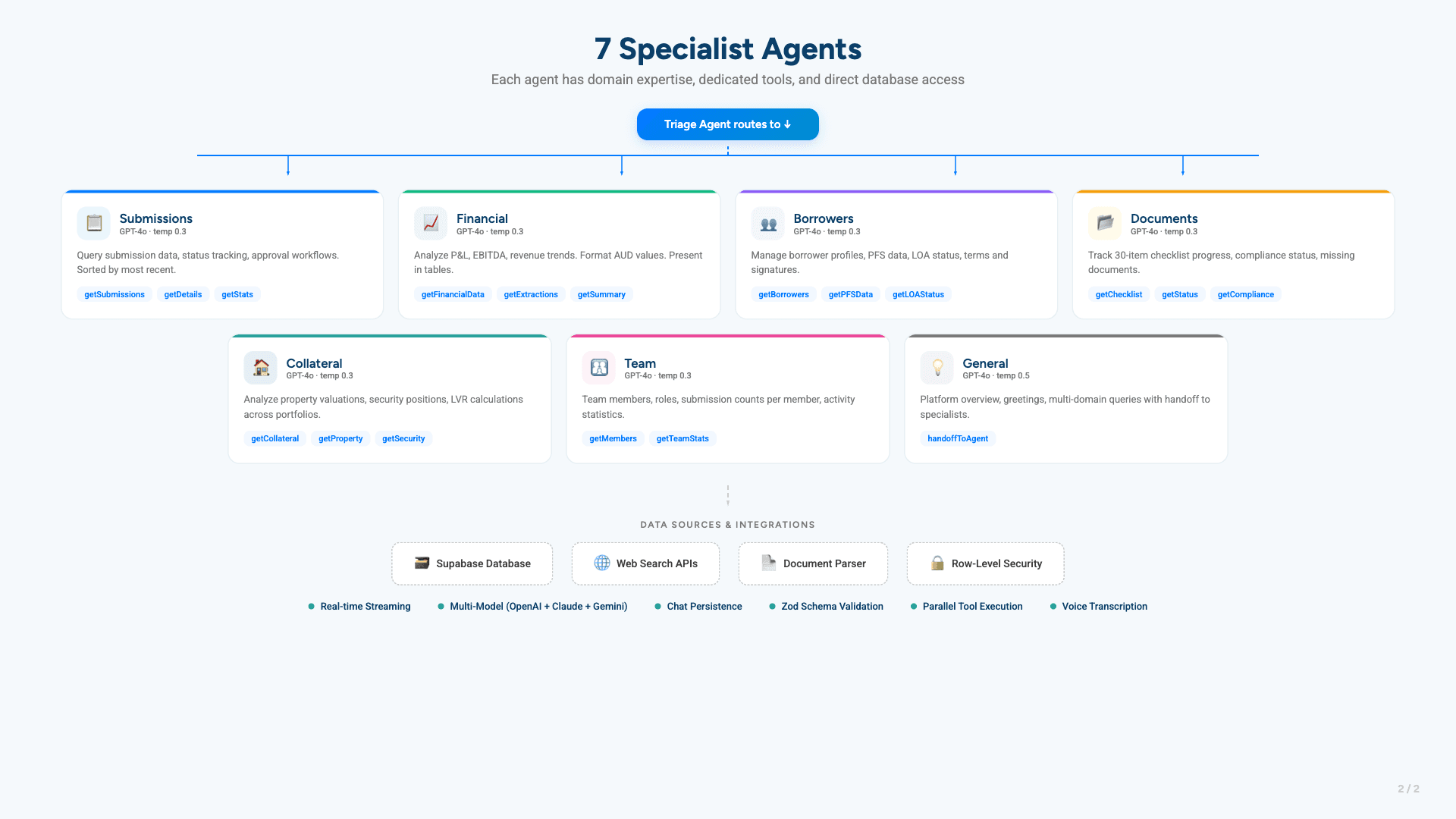
Once classified, the query is handed to one of seven domain experts:
| Agent | What It Does | Key Tools |
|---|---|---|
| Submissions | Query submission status, approvals, pipeline data | getSubmissions, getDetails, getStats |
| Financial | Analyze P&L, EBITDA, revenue trends, balance sheets | getFinancialData, getExtractions, getSummary |
| Borrowers | Manage borrower profiles, PFS data, LOA status | getBorrowers, getPFSData, getLOAStatus |
| Documents | Track 30-item compliance checklist progress | getChecklist, getStatus, getCompliance |
| Collateral | Analyze property valuations, security positions, LVR | getCollateral, getProperty, getSecurity |
| Team | Team member management and performance stats | getMembers, getTeamStats |
| General | Platform overview, greetings, multi-domain handoff | handoffToAgent |
Each agent runs on Claude Sonnet with a temperature of 0.3 — low enough to minimise hallucination on financial data, but flexible enough for natural conversation. Each has access to specific database tools scoped to its domain, enforced by Row-Level Security at the database layer.
Beyond the Chat: AI Across the Entire Workflow
The multi-agent assistant is the centrepiece, but AI is woven throughout the platform:
Financial Document Extraction
Upload a P&L statement as a PDF and the system extracts structured financial data — NPBT, depreciation, interest, EBITDA, tax, and YoY growth rates. The extraction runs on Claude with Zod schema validation guaranteeing the output structure. We chose Claude because long-context handling and consistent structured-output adherence on dense lender documents matter more here than headline benchmark scores.
What used to take an analyst 30-45 minutes per document now takes 30 seconds.
AI Business Intelligence
Enter a company name and the system searches the web for comprehensive business information — ABN, ACN, directors, corporate structure, industry classification, registered addresses. Every piece of data comes with source citations for audit trail compliance, powered by Claude's web search tool.
Context-Aware Field Generation
Throughout the forms, "Ask AI" links let users generate content with full context awareness. A property description generator, for example, reads the address, property type, zoning, and valuation from the form before generating a lending-grade description. One click, contextually relevant, immediately usable.
Voice Input
The chat widget supports voice queries via OpenAI transcription with echo cancellation and noise suppression. Speak a question, watch it transcribe, and the multi-agent system handles the rest. Useful for analysts reviewing documents on screen who want to query data hands-free.
Technical Decisions That Mattered
A few architecture choices that proved important:
Two-tier model strategy. Using Claude Haiku for triage and Claude Sonnet for specialists balances cost, speed, and quality. The triage step adds negligible latency but dramatically improves response relevance.
Streaming responses. All agent responses stream via Server-Sent Events. Users see the answer forming in real-time rather than waiting for a complete response. This matters when financial analysis responses can be lengthy.
Standardised on Claude. We initially built the platform to be provider-agnostic — abstracting the AI layer so we could swap models per workflow. After production benchmarking on real lender documents, we standardised on Claude across the board. Long-context reasoning on 80+ page submissions, structured-output adherence under Zod validation, and reliable tool use for agentic workflows all favoured Claude consistently enough that the multi-provider abstraction stopped earning its complexity.
Chat persistence. Every conversation is saved to the database with full message history, tool calls, and agent metadata. Users can return to previous conversations, and the system maintains context across sessions.
Schema validation everywhere. Every structured AI output is validated against a Zod schema before being persisted. This catches hallucinated fields, wrong data types, and missing values before they reach the user.
Why Claude Anchors Our AI Stack
For a regulated, document-heavy workflow like commercial credit assessment, model choice isn't about benchmark leaderboards — it's about which model fails gracefully on the work that actually matters. Claude is our default for three reasons:
1. Long-context reasoning on real lender documents. A single commercial credit submission can run 80+ pages across financial statements, valuation reports, borrower profiles, and compliance schedules. Claude's long context window lets us reason across the full submission without aggressive chunking — which means fewer extraction errors and better cross-document reconciliation (matching EBITDA in a P&L against debt service coverage in a valuation, for example).
2. Structured-output reliability under schema validation. Every AI output in the platform is validated against a Zod schema. In our testing, Claude has been the most consistent on tool-call adherence and structured financial output — especially on numbers, dates, and enum fields. That reliability matters when a single hallucinated figure can fail a credit decision downstream.
3. Agentic tool use and MCP-native workflows. Our broader Sandlabs platform exposes compliance, commission tracking, and submission tooling via MCP servers used in production across multiple brokerages. Claude's agentic capabilities and native MCP support make it the natural default for any workflow that orchestrates multiple tools and data sources — which is most of what we build.
Those three reasons compounded across the workflow: the same model handles document extraction, agent reasoning, web search, and tool orchestration. One model family, one set of evals, one mental model for the team. That consistency is the practical payoff of standardising on Claude.
The Stack
For those interested in the technical foundation:
- Framework: Next.js 15 with App Router and React Server Components
- AI SDK: Vercel AI SDK v5 with @ai-sdk/anthropic (Claude Haiku for triage, Claude Sonnet for specialists, extraction, and web search)
- Database: Supabase with Row-Level Security
- UI: shadcn/ui + Radix UI + Tailwind CSS
- State: Zustand for chat state, nuqs for URL state
- Voice: OpenAI gpt-4o-mini-transcribe model
- Type Safety: Full TypeScript with Zod schema validation
Results
The platform has been running in production for six months. The headline numbers:
- End-to-end submission time cut from ~1 week to ~3 hours — roughly a 13× speedup on the work that defines an analyst's day.
- ~50 commercial credit submissions per month processed through the Claude-powered pipeline.
- 10 brokers actively using the platform, with 8-10 analysts working with the multi-agent assistant daily.
- Document extraction that previously took 30-45 minutes per file now completes in 30 seconds.
- Schema validation catches structured-output errors before they reach the analyst, so the hallucination tail that usually disqualifies LLMs from regulated workflows stays bounded.
The real win is the end-to-end compression. By the time an analyst would have finished manually gathering inputs in the old process, the Claude pipeline has already extracted financials, populated the borrower profile, run business intelligence on the entity, surfaced compliance gaps, and prepared the submission packet for review.
More importantly, it's changed how analysts work. Instead of context-switching between spreadsheets, PDF viewers, and compliance trackers, they ask the AI assistant — and it routes to the right Claude-powered specialist automatically.
We build AI-native applications for financial services. If you're looking to integrate AI into your workflow — not as a gimmick, but as a core part of how your team operates — explore our AI & Claude consulting services or get in touch.