
Production Software for Decoration & Apparel Manufacturers (Embroidery, Screen Print, Promo)
by Sandlabs Team, Founder, Sandlabs
If you run a decoration or apparel business — embroidery, screen print, DTG, promotional products, finishing — and you have gone looking for production software, you have probably found two kinds of tools and nothing in between.
On one side: artwork and digitising software — for designing stitches, separating colours, laying out a print. On the other: enterprise manufacturing platforms — built for car parts and electronics, priced for plants ten times your size. Neither runs your floor.
This is the gap most decorators live in. Here is why it exists, and what a system built for your work actually looks like.
Why generic software doesn't fit decoration
Decoration is its own kind of manufacturing. An order isn't one item — it's a job with garments, placements, a logo, an artwork approval, a machine that suits it, and a dispatch deadline. The work moves through stations, not a single assembly line, and the same job might touch embroidery, print and finishing before it ships.
Generic production platforms don't model that well. They assume standardised lines and bills of materials, so you spend months bending the software to your process — and still end up tracking the real status in a spreadsheet on the side. That is the worst of both worlds: enterprise cost, spreadsheet reality.
What decoration production actually needs
The backbone is simpler than the platforms make it look. One live view of every order, moving through a clear flow:
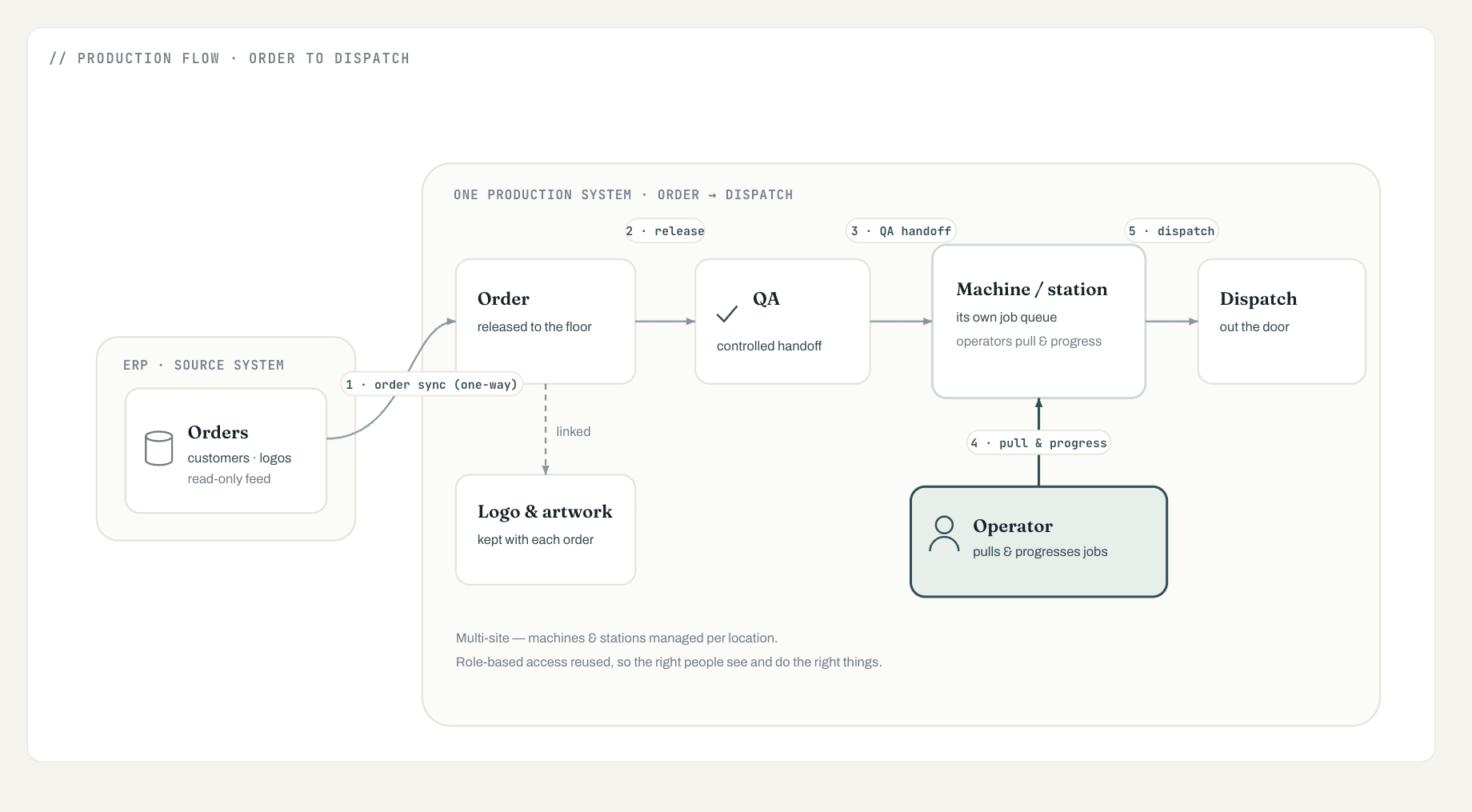
- Order — released to the floor, fed in from your existing systems so nobody re-keys it.
- QA — a controlled handoff so work only moves forward when it is ready.
- Machine / operator station — each machine shows its own queue; operators pull and progress their own jobs.
- Dispatch — every order visible right through to out-the-door.
Two things matter especially for decorators: logo and artwork records stay attached to each order, and the system is multi-site aware, with machines and stations managed per location. We built exactly this for an Australian embroidery, print and finishing business — the full story is in From Spreadsheets to One Production System.
Embroidery, screen print, promo — one backbone, different stations
The reason a purpose-built system works across decoration methods is that they share the backbone and differ only at the station:
| Method | Station specifics | Same backbone |
|---|---|---|
| Embroidery | Hooping, thread, machine head count, digitised file | Order → QA → station → dispatch |
| Screen print | Screens, colours, cure, registration | Order → QA → station → dispatch |
| DTG / DTF | Pre-treat, print, cure | Order → QA → station → dispatch |
| Promo / finishing | Decoration method per item, kitting | Order → QA → station → dispatch |
You don't need a different system per method — you need one production system that understands jobs, stations and queues, with the method-specific detail captured per job.
Don't confuse artwork tools with a production system
This is the single most common mix-up. Searches for "embroidery software" or "screen printing software" mostly return artwork and digitising tools — they make the design, they don't run the floor. A production system is the layer above: it doesn't draw the logo, it makes sure the job carrying that logo doesn't stall between QA and the machine. You will likely use both; just don't expect one to do the other's job.
If you want the broader landscape — production system vs MES vs ERP and which fits a business your size — we lay it out in Production System vs MES vs ERP. And the day-to-day heart of it is covered in job and production tracking.
Build vs buy for decorators
Because the decorator-specific software market is thin, "buy" often means compromise. The realistic options:
- Adapt a generic MES/ERP — possible, but you pay for scale you don't have and bend your process to fit.
- Stitch together point tools — a quoting tool, an artwork tool, a spreadsheet — which is where most shops are, and where jobs slip through the cracks.
- Build a purpose-built system — shaped to your flow, delivered as a complete first version, then grown in funded phases (barcode scanning, machine integration, automated scheduling) once the core is proven.
For a growing decorator with a clear way of working, the purpose-built route usually wins — not because building is always right, but because nothing off the shelf actually fits how decoration runs.
We build production systems for decoration, apparel and print manufacturers — order to dispatch, shaped to your floor, hosted in Australia with your data staying yours. If your orders, QA and machines live in separate tools, a short scoping call shows what one system would look like — explore our AI & software consulting or get in touch.