
Production System vs MES vs ERP: What a Growing Manufacturer Actually Needs
by Sandlabs Team, Founder, Sandlabs
If you run a growing manufacturing business — a decoration and apparel shop, a print or sign business, a job shop — and you have started looking for software to get off spreadsheets, you have probably drowned in acronyms. Production management system. MES. Manufacturing ERP. Shop floor control. Vendors use them interchangeably, but they describe different things at very different price points.
This guide cuts through it: what each option actually is, what it costs you in money and time, and which one fits a business your size.
The short version
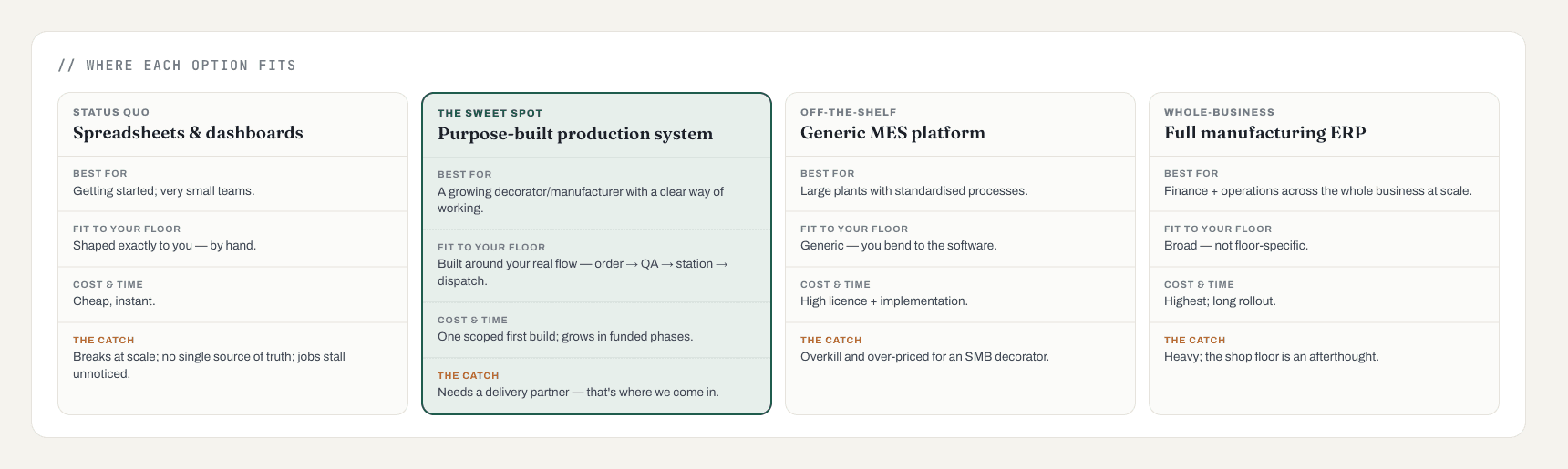
- Spreadsheets and dashboards are where almost everyone starts — and most manufacturers never leave. Cheap and flexible, until they aren't.
- A production management system runs the floor: it tracks every order through its stages, from release to dispatch.
- A manufacturing execution system (MES) is the enterprise-grade version of that — built for large plants and standardised lines.
- A manufacturing ERP runs the whole business — finance, inventory, purchasing — with production as one module among many.
The trap most growing manufacturers fall into: they assume the choice is "spreadsheets or a big platform," when the option that usually fits best is a purpose-built system sized to exactly how they work.
What a production management system does
Strip away the jargon and a production management system answers one question continuously: where is every order, right now?
A good one models your actual flow. For a decorator that looks like order → QA → machine/operator station → dispatch, with orders fed in from your existing systems so nobody re-keys them. Each station shows its own queue; operators pull and progress their own jobs instead of chasing paper.
We walk through exactly that flow — and the trade-offs of building it — in our case study, From Spreadsheets to One Production System. The two capabilities that make it work day to day are worth their own reads: job and production tracking (knowing the live status of every job) and work-order management and scheduling (controlling what happens next).
When you actually need a full MES or ERP
These platforms are real and they are good — at the scale they are built for.
A full MES makes sense when you run large, standardised production lines, often across multiple plants, and you need deep machine-level integration, automated capacity planning and compliance reporting out of the box. The global MES market is worth $16.5B+ and growing ~10–15% a year for exactly those buyers.
A manufacturing ERP makes sense when your real problem is running the whole business — finance, inventory, purchasing, payroll and production — from one system, and you are willing to standardise your processes around the software.
The catch for a growing decorator or job shop is the same in both cases: you bend to the platform, not the other way around — and you pay enterprise licence and implementation costs for capabilities you will not use for years.
The fourth option most people miss
Between "spreadsheets that break" and "a platform that is overkill" sits a purpose-built production system — software shaped around your real flow, delivered as a complete first version, then grown in funded phases.
| Spreadsheets | Purpose-built system | Generic MES | Full ERP | |
|---|---|---|---|---|
| Fits how you work | By hand | Yes, by design | You adapt | You adapt |
| Cost to start | ~Nothing | One scoped build | High | Highest |
| Time to value | Instant, then degrades | Weeks to a first system | Months | Many months |
| Scales with you | No | Yes, in phases | Yes | Yes |
| Best for | Very small teams | Growing SMB manufacturers | Large plants | Whole-business at scale |
For most businesses doing decoration, apparel, print or job-shop work, the purpose-built option wins because the decorator-specific software market is thin — generic platforms are over-built, and the lightweight tools are designed for artwork and quoting, not floor management. We go deeper on that in Production Software for Decoration & Apparel Manufacturers.
How to choose
A quick decision guide:
- Stay on spreadsheets only if you are small, simple, and orders rarely stall. Be honest about that last one.
- Buy a full ERP if your primary pain is finance and whole-business operations, not the floor.
- Buy a generic MES if you run large standardised lines and need machine-level integration on day one.
- Build a purpose-built production system if you have a clear way of working, the floor is where your pain is, and nothing off the shelf fits it. Start with the core flow — order to dispatch — and add the heavy pieces (barcode scanning, machine integration, automated scheduling) as funded follow-ons once the core is proven.
Where to start
You do not need to pick the whole roadmap on day one. You need one live view of every order, and a first system that survives daily use on the floor. Everything else can be added in deliberate phases.
We build production-grade systems for manufacturers across Australia and beyond — sized to how you actually work, not how a platform wants you to. If you are weighing spreadsheets against a heavy platform, a short scoping call is the fastest way to see the third option — explore our AI & software consulting or get in touch.